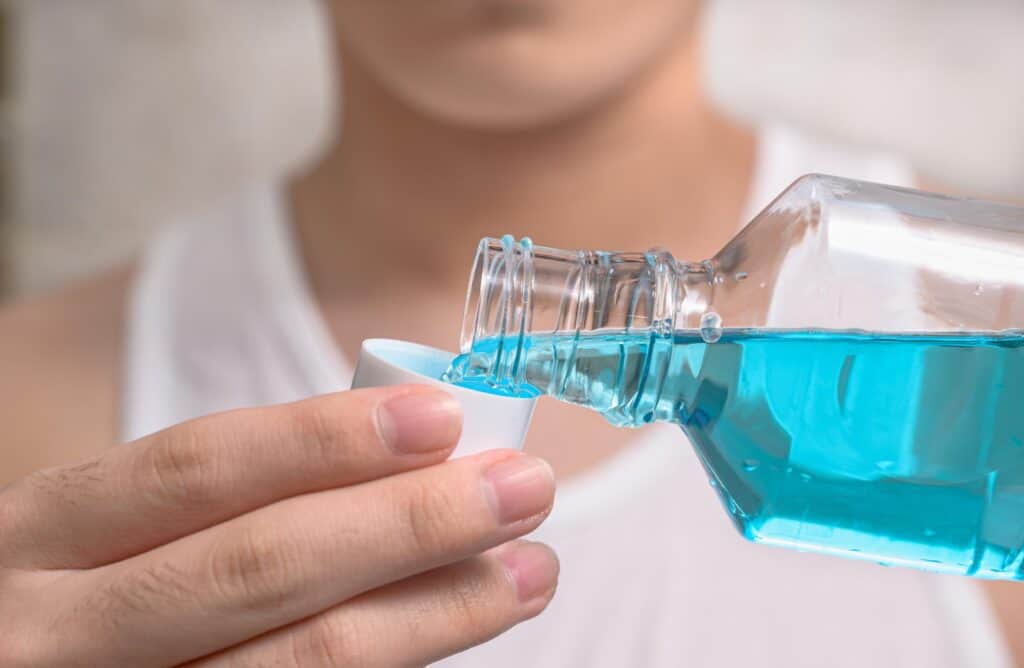
What happens if you drink mouthwash depends on how much. A swallowed mouthful during rinsing does almost nothing. A bottle drunk on purpose delivers as much ethanol as a few shots of liquor, along with a mix of ingredients like menthol, methyl salicylate, and benzoic acid that were designed to be spat out, and it can cause alcohol poisoning, stomach damage, and metabolic acidosis. People drink mouthwash for one reason in nearly every case. They cannot get alcoholic beverages, and mouthwash is on the bathroom counter.
What Happens If You Drink Mouthwash? Health Effects by Amount
A Small Amount of Alcohol Containing Mouthwash
Accidental ingestion of a mouthful is not an emergency. You may feel a throat burn, mild nausea, or a bit of dizziness. Rinse with water, follow it with drinking water, and move on. The same applies if a child swallows a sip while learning to rinse, though Poison Control asks parents to call anyway, since children under six reach toxic levels on far less.
Large Amounts and Ethanol Toxicity
Drink mouthwash by the bottle and the ethanol behaves like any other alcohol, only faster, because there is no food or carbonation to slow it. Acute ingestion of larger quantities is where the real risks start. A 500 ml bottle at 27 percent holds about 135 ml of pure ethanol, roughly the same as four to five standard drinks. Ethanol toxicity follows, with the same risks as any binge.
- Nausea, vomiting, and stomach pain, made worse by the menthol and other irritants.
- Dizziness, slurred speech, and poor coordination.
- Drowsiness, then difficulty staying awake.
- Slow breathing, low blood sugar, and low body temperature.
- Coma and death at high enough doses, the same as alcohol poisoning from liquor.
The Other Active Ingredients, Methyl Salicylate, Menthol, and Benzoic Acid
Ethanol is the most toxic ingredient by exposure, the second most toxic ingredient depends on the brand, and the other substances add their own risks. A quantitative risk assessment of 30 mouthwash brands from German and Canadian markets, published in Food and Chemical Toxicology and indexed by the National Library of Medicine, found that every one of the investigated brands contained alcohol, and most contained menthol, eucalyptol, benzoic acid, and methyl salicylate as active ingredients.
For low risk drinking scenarios with average levels of use, only ethanol will exceed acceptable daily intakes. For extreme exposures, methyl salicylate can exceed its acceptable daily intake by a factor of 17. The quantitative risk assessment based its average scenarios on someone drinking a bottle a day and its worst case on several, close to what dependent consumers actually do.
Methyl salicylate is wintergreen oil, a relative of aspirin. In large amounts it causes ringing in the ears, rapid breathing, confusion, and metabolic acidosis, a dangerous drop in blood pH. Chronic ingestion in dependent consumers adds up over weeks. Hydrogen peroxide, in the whitening rinses, irritates and can damage the digestive tract, and hydrogen peroxide poisoning is its own reason to call Poison Control. Chlorhexidine, in prescription rinses, carries its own risks in large quantities. Fluoride in some oral rinses causes vomiting, diarrhea, and electrolyte problems.
The literature offers limited evidence on the long term health effects, because most people who drink mouthwash regularly also drink other alcohol and rarely end up in studies. What is known points to the same liver damage, brain changes, and cancer risks as heavy alcohol abuse, with the added acid load and stomach irritation from everything else in the bottle. Every adverse effect of heavy drinking gets worse when the drink was never meant to be swallowed, and the adverse effects of the other substances stack on top.
Is Mouthwash Alcohol? Ethanol Content and Alcohol Free Mouthwash
Most of it, yes. Is mouthwash alcohol in the way beer or wine is? Chemically, close enough. Alcohol containing mouthwash uses ethanol, the same alcohol found in beer, wine, and liquor, as a solvent and preservative that keeps the flavoring agent and antiseptic ingredients dissolved. Poison Control puts the range at about 5 to 27 percent alcohol by volume. Original Listerine sits near the top at 26.9 percent, stronger than wine.
Alcohol free mouthwash exists and works about as well for oral hygiene and oral health. The American Dental Association recommends it for people with dry mouth and notes that children younger than six should not use any mouth rinse, because they swallow it.
Alcohol free mouthwash has taken a larger share of store shelves in the past decade, partly because dentists ask for it and because the alcohol was never doing much for oral health in the first place. The active ingredients that fight bad breath and gum disease work with or without it.
Is the Alcohol in Mouthwash the Same as Liquor?
Chemically, yes. Ethanol is ethanol whether it comes from a distillery or a mouthwash plant. The difference is everything mixed in with it. Beverage alcohol is made to be swallowed. Mouthwash is made to kill harmful bacteria for 30 seconds and leave. The menthol, eucalyptol, thymol, and methyl salicylate that make it work as a mouth rinse are the part that makes it dangerous to drink in large amounts.
Why Do People Start Drinking Mouthwash? Surrogate Alcohol and Alcohol Use Disorder
Almost nobody drinks mouthwash because they like it. People start drinking mouthwash when they cannot get beverage alcohol and their body demands it. That makes it a surrogate alcohol, the same category as hand sanitizer, rubbing alcohol, and cooking wine. Public health researchers call this non beverage alcohol use, and non beverage alcohol shows up wherever alcoholic beverages are expensive, banned, or hidden.
- Alcohol use disorder. Someone with severe alcohol dependence who runs out of alcohol at 2 a.m., or who is trying to hide how much they drink, reaches for the closest ethanol. Hospital studies have found many alcohol dependent patients have used mouthwash this way.
- Restricted availability. Mouthwash is drunk in places where alcoholic beverages are banned or hard to get, including prisons, some military establishments, treatment facilities, and dry communities.
- Cost. Mouthwash is cheap, legal, sold in drug stores everywhere, and nobody looks twice at the purchase.
- Teenagers. Some teens start drinking mouthwash because it is in the house, they cannot buy beer or wine, and they believe it will not show up on a breath test. It does.
- Hiding drinking. Mouthwash covers its own smell, which appeals to people drinking at work or around family.
Nonbeverage alcohol use is a serious problem in its own right and a marker for severe alcohol addiction. Someone drinking mouthwash has usually passed the point where willpower is a factor. The fix is treatment for the alcohol use disorder underneath, and hiding the mouthwash only moves the problem to the hand sanitizer.
Is It Safe to Swallow Mouthwash? Risks by Amount
Is mouthwash safe to drink in small amounts? Swallowing a little by accident is safe for adults. Swallowing it on purpose is not, at any amount that matters. The risks scale with volume and with how often people swallow mouthwash.
- One mouthful, once. Harmless for most adults. Rinse and drink water.
- A few mouthfuls. Mild alcohol effects, possible stomach upset. Watch for vomiting.
- Half a bottle or more. Call Poison Control at 1-800-222-1222. Ethanol toxicity is likely, and methyl salicylate poisoning is possible.
- Any amount in a child under six. Call Poison Control. Children reach toxic blood alcohol levels on a few ounces.
- Regular drinking in any amount. That is alcohol abuse at minimum and usually alcohol use disorder, and it needs treatment.
The Consumer Product Safety Commission requires child resistant closures on mouthwash containing 3 grams or more of ethanol per package, which is nearly all alcohol containing brands. That rule exists because mouthwash poisonings in young children were common before it.
What to Do If Someone Drinks a Lot of Mouthwash
- Call Poison Control at 1-800-222-1222. They will tell you whether the amount and ingredients need an emergency room.
- If the person is vomiting repeatedly, confused, breathing slowly, or cannot stay awake, call 911. Those are signs of ethanol toxicity or metabolic acidosis.
- Do not make them vomit. Mouthwash irritates on the way back up and raises the risk of choking.
- Keep them awake and sitting up if possible, or on their side if not.
- Note the brand and how much is gone from the bottle. The ingredients matter for treatment.
Adults who drink mouthwash repeatedly need the same medical evaluation as anyone with heavy alcohol use, and often the same supervised withdrawal, since stopping suddenly after heavy daily ethanol intake can cause seizures. How long detox takes depends on how much and how long.
Frequently Asked Questions
Yes, for about 15 minutes after rinsing, because alcohol lingers in the mouth. Drinking mouthwash raises blood alcohol the same way liquor does and will register on any breath or blood test.
The original amber Listerine and most of the Cool Mint line contain 21 to 27 percent alcohol. Listerine Zero and the alcohol free versions contain none. Check the mouthwash label.
It can be misused as one, and people do. It cannot be used safely. Every ingredient besides the ethanol is dosed for spitting rather than swallowing, and the risks climb with every bottle.
Most do not. Some steer patients away from alcohol containing mouthwash because it dries the mouth, which worsens bad breath and gum disease over time. The American Dental Association found no link between normal mouthwash use and oral cancer.
Because they cannot get alcoholic beverages at that moment. Mouthwash is legal, cheap, already in the house, and does not smell like drinking. Nobody chooses it over liquor when liquor is available.
Yes. The ingredients that handle bad breath are the antiseptics and flavoring agents, and they work without ethanol. Alcohol free versions are also gentler on dry mouth.
No. Drinking mouthwash on purpose is a recognized sign of severe alcohol addiction, and drinking mouthwash or any surrogate alcohol usually means the person has run out of other options. Public health data on surrogate alcohol comes mostly from prisons, hospitals, and poisoning reports.
Help for Alcohol Abuse and Addiction in Exton, PA
If you or someone you love has been drinking mouthwash, the mouthwash is the least of it. It means alcohol addiction has reached the point where the body will take ethanol from anywhere, and that is treatable. The health effects of surrogate alcohol reverse faster than most people expect once the drinking stops.
MPower Wellness treats alcohol addiction in Exton, PA, with dual diagnosis programs built around the anxiety, depression, or trauma that usually sits underneath heavy drinking, and with medication management to make early sobriety survivable. If withdrawal needs medical supervision first, we can connect you with detox and take it from there. Call (484) 517-3005, contact us online, or verify your insurance to start admissions.
Sources
- Lachenmeier, D. W., Monakhova, Y. B., Markova, M., Kuballa, T., & Rehm, J. (2013). What happens if people start drinking mouthwash as surrogate alcohol? A quantitative risk assessment. Food and Chemical Toxicology, 51, 173–178.
- National Capital Poison Center. (n.d.). Mouthwash: Swish and spit.
- American Dental Association. (2026). Mouthrinse (mouthwash).
- Consumer Product Safety Commission. (n.d.). 16 CFR § 1700.14, Substances requiring special packaging.